Stereotypes emerge from patterns observed among a minority of certain groups. When Subaru came out with their Outback Wagon, it seemed like they were targeting people who might idolize Paul Hogan or Steve Irwin. After encountering at least the third different Outback occupied by two flannel-clad women and a German Shepherd, expectations would form about those who naturally found this model appealing. Certainly, most Outbacks on the road did not fit that particular stereotype, but there was nothing in common among the occupants of the every other Outback that stood out enough to challenge those particular observations.
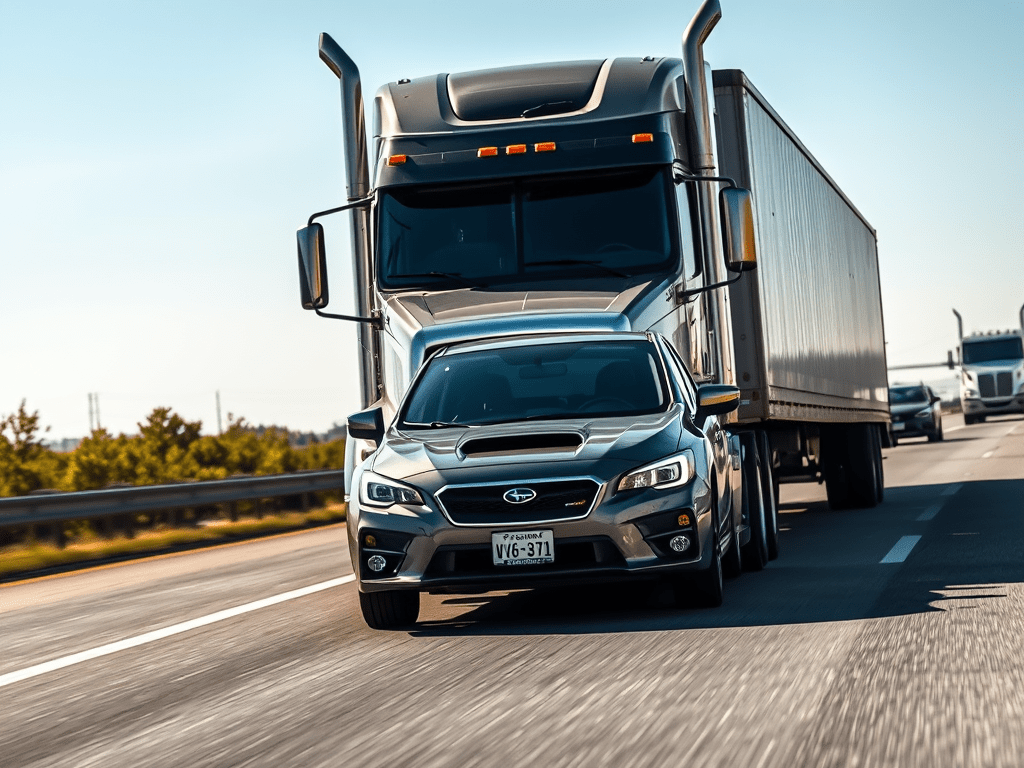
I’ve learned from other truck drivers that there are other observable patterns with types of cars on the road. Subarus in general seem to have a reputation for causing problems for truck drivers. The same can be said about the Toyota Prius. I’m highly confident that by far the majority of Subaru drivers on the road are non-problematic for truckers. I’m not so sure about the Prius. So far, in my experience, there have been more Subarus that have pulled this particular maneuver with me than any other make of car, though it happens with all kinds of cars. Also, while it has happened more often in California, it is certainly not unique to any particular state.
When driving a truck, the rightmost lane is usually highly desirable. That way traffic problems (erratic drivers) are most likely limited to one lane on the left side, which is much easier to see, not to mention that is where the slowest movers (me: Captain Put-Put) belong. The major exceptions occur with merging traffic. In metro areas with lots of on-ramps and high vehicle inflow, it is best to move over a lane or two when possible to avoid merging conflicts. Most drivers are able to negotiate the timing to either get ahead of the truck before the merge point, or to back off and pull in behind it, but this is not true for all drivers.
With the Subaru Merge, the merging vehicle remains on a collision course with a truck.. Let’s say the general speed limit is 70 mph, and the truck speed limit is 65 mph. The Subaru merger tends to want to compromise at 60 mph, and they are willing to die on that hill. Literally. Because that is what will happen if neither driver gives way–which is the obligation of the merging vehicle. However, one of us is a professional driver and will end up yielding.
My first Subaru Merge happened on Highway 89 between Ogden and Farmington, Utah, at the bottom of a hill while I was carrying a total of 78,000 lbs. Momentum is so important when ascending hills–especially heavy-laden–and I lost all of it when I had to brake to allow someone to merge in front of my truck instead of underneath it. I ended up climbing this hill at a sudden 27 mph instead of a more gradual slowdown to 40. You can probably imagine the mad scramble of cars jockeying to get around me that this caused–which I was able to observe more than usual because, while I didn’t die on this hill, I was only able to ascend it with all the speed and agility of a shuffling old man pushing a walker and dragging a rolling IV pole.
Needless to say, a new source of anxiety for me is every incoming freeway merge. I can’t really do anything to prevent a Subaru Merge, so I have to live with it. Of course, this isn’t the only stressful situation at an on-ramp. There is nothing quite like the relief of thinking I’ve successfully crossed an open merge lane to the security of the white shoulder line on my right only to see a car shooting out of my blind spot to fly past me on that shoulder. I actually prefer that one because they tend to be gone as quickly as they appeared.
 (The Road) Ain't No Place